Westchase Fairway Homes and the Golf Course Talks Behind Them
November 19, 2026
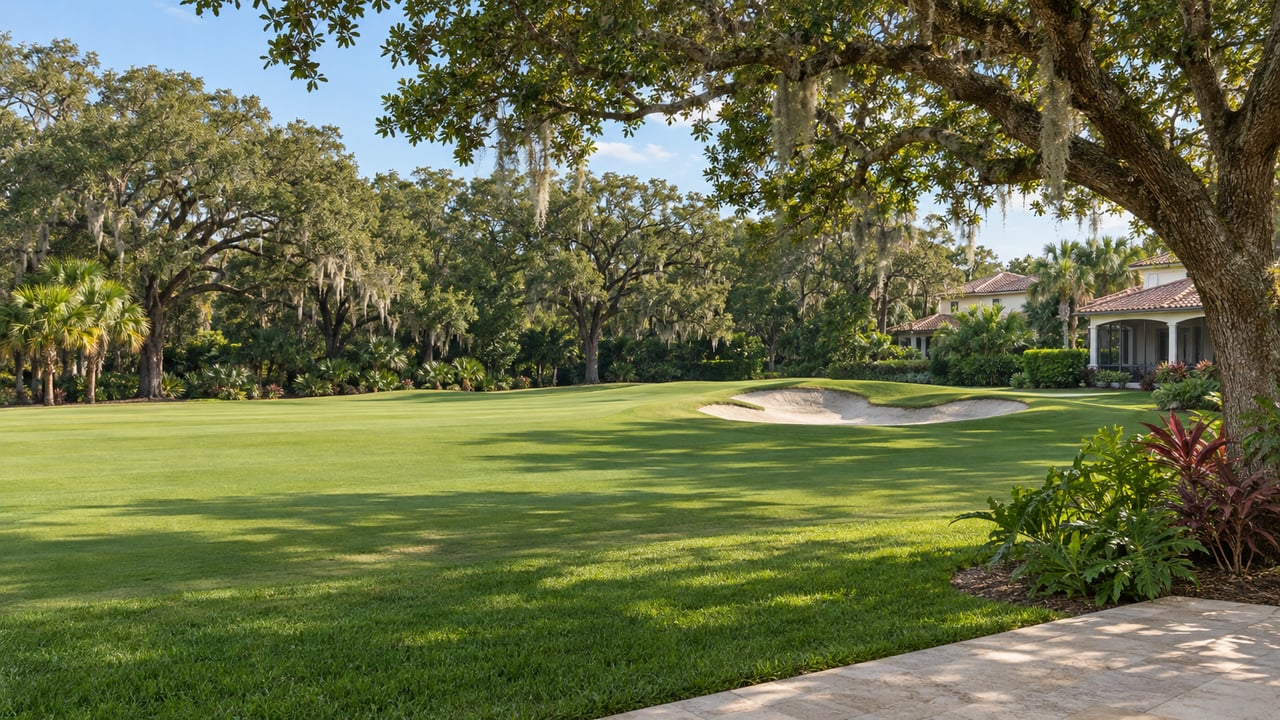
"This is 200 acres in the middle of Westchase – it will benefit us all," then-Supervisor Greg Chesney said at the February 17 Westchase CDD workshop, according to Westchase WOW's account of the meeting. He meant the Westchase Golf Course. Since 1992 it has been the green middle of the community, and one private owner holds it. By the October 21 workshop, CDD Supervisor Reggie Gillis was telling residents that the owner is shopping the course around.
A fairway view on a Westchase listing depends on a privately owned business. That business recovered from losing money in 2018 to an estimated profit in 2025, and the owner's sense of its value now rests on recent sales in a busy golf market. The closest local comparisons show that when a community course closes or changes hands, the outcome plays out over years. A buyer looking at The Greens, Harbor Links or The Estates is pricing a house and also a negotiation that hasn't finished.
The board has looked at buying the course before. In 2018 it hired golf consultant Greg Christovich, who found a course that was losing money and carried about $1.3 million in deferred maintenance. The asking price was $2 million above his valuation, and the board passed.
The numbers Christovich brought back in February 2026 describe a different business. He put estimated current revenue at $3.5 million on 47,000 rounds, which is double the 2018 count, and estimated 2025 EBITA at $1.1 million. He also said capital needs are likely much higher than in 2018 because the course hasn't had major improvements. He described a "feeding frenzy" of private equity and institutional buyers acquiring golf courses, something he said the industry hadn't seen in 35 years, and said the seller bases his price on recent deals such as Cheval and Lakewood Ranch.
Cheval is in Lutz. Heritage Golf Group announced on April 21, 2025, that it had bought The Club at Cheval from LKJ Management. The Tampa Bay Business Journal reported the price at $4.6 million.
In 2018 the board could weigh a money-losing course against its own valuation and walk away. In 2026, the seller's price reference is a market where, by Christovich's account, institutional buyers are paying high prices for courses. Any price the CDD considers will be measured against those deals as well as against the course's condition.
The board has moved through its formal steps in 2026 slowly and on the record:
Gillis also said legal counsel should review the course's current conservation easements, along with future deed restrictions and financing options. Greg Chesney, who has served as the CDD's liaison with the owner for years, was scheduled to meet the owner in November for informal talks and then connect him with Christovich. Supervisor Chris High asked that Christovich look into government programs that might help fund course improvements, and he called the course a legacy the board should preserve.
The $6.5 million figure is about six times the course's estimated 2025 earnings, before any renovation. For the household-level scale, Gillis pointed back to an $18 million trails bond the board had discussed and has since dropped, which he said would have worked out to about $200 per household.
When CDD supervisors explain what is at stake, they point to Pebble Creek and Plantation Palms. The two courses took very different paths.
Pebble Creek Golf Club in New Tampa opened in 1967 and sold for $2.1 million in 2005, as the Tampa Bay Times reported. The course closed for good on July 31, 2021. More than five years later, on September 22, 2026, Hillsborough County commissioners voted 5-2 to approve a rezoning that lets GL Homes build 251 single-family homes and five neighborhood parks on the nearly 150-acre former course. The Times later reported that Save Pebble Creek and eight residents petitioned for court review on October 21. The Times also described a neighborhood split between people who opposed new housing and people who preferred the GL Homes plan to a fenced, deteriorating course.
Plantation Palms in Land O' Lakes went the other way. The course closed in spring 2014. That August, the Tampa Bay Times reported that agents were seeing less buyer interest, including three prospective buyers who turned down one golf-view listing because of the course's condition. In 2016, Ace Golf agreed to buy the 156-acre course for $700,000 and planned at least $1.5 million in repairs. Through a "Bring Back Our Course" effort, about 70 percent of homeowners approved a $15 monthly dues surcharge for social memberships at the club. The course reopened in 2016, according to later Times reporting. The Plantation Palms website lists tee times, a driving range and mini golf.
Plantation Palms took about two years to reopen, and Pebble Creek went more than five years from closing to a rezoning vote that is now being challenged in court. Westchase starts from a stronger position than either course did, with a course that earns money and a CDD board that is already doing due diligence. In Westchase WOW's account of the February workshop, Supervisor Chris Barrett pointed to the front of the course as the area with the most potential for high-density development, and said the rest of the course could also be developed piecemeal, depending on zoning. At that same February meeting, a resident asked how much home values might fall if the course stopped being a golf course, and the board said it hadn't gotten that far yet.
The golf course runs through the villages where fairway frontage shapes value most. The Greens is six single-family villages behind a staffed gate, and golf frontage and lot position are among the main differences in value there. Harbor Links is a gated golf neighborhood with larger lots, and The Estates has the community's largest lots and custom or semi-custom homes along the course. North of Linebaugh, The Bridges includes the single-family villages of Baybridge, Wakesbridge, Sturbridge and Stockbridge, along with the gated villa enclaves Stonebridge and Woodbridge.
A buyer in those villages is carrying the current association costs plus a possible future one. The Westchase Community Association approved a 2027 assessment of $465 per household on October 8, which is $12 less than in 2026. At the CDD's August budget hearing, a Harbor Links resident said the FY 2026-27 general fund assessment was rising 6.08 percent. Supervisor Barrett pointed to higher landscaping and pond contracts and to sidewalk repairs the CDD took on, and he noted that the community is now 35 years old. A bond for the golf course would come on top of these costs. At the February workshop, a Greens resident said she supported the idea of community ownership but was concerned about upkeep costs.
These figures are general information, not legal, tax or financial advice, so please confirm your own costs with the right professional before you write an offer.
Paying a premium for a fairway lot today is a bet on three things. The course stays a course, the cost of keeping it that way stays at a level owners will accept, and whatever happens unfolds slowly enough that resale isn't affected while you own the home. Neither Pebble Creek nor Plantation Palms changed quickly. Gillis is holding community outreach sessions one hour before each monthly CDD workshop to keep residents informed, and the Westchase CDD website posts the date, time and location. A buyer under contract on a frontage home can attend one before closing.
Buyers weighing Westchase against newer construction can also look at Starkey Ranch a few miles north. That community has its own costs, which we cover in how Starkey Ranch's fee stack works.
If you own a home along the Westchase fairways and want to know what that frontage is worth while the course's future is still being negotiated, Anne Bromberg Luxury Group is glad to help you think it through. Start with Get Your Home Valuation.
Stay up to date on the latest real estate trends.
Blog
Blog
Blog
Blog
Blog
Blog
Blog